Originally published in The Gardener Magazine, Spring 2026
One of Canada’s most popular and beloved ornamental evergreens is fighting for its life. The boxwood shrub (Buxus spp.) has recently come under serious attack by the box tree moth (Cydalima perspectalis). This invasive species has decimated it in every province from Ontario east to the Maritimes, with serious concerns about its potential westward spread. If not caught early and consistently managed, the box tree moth causes severe defoliation and eventual death of the shrub.
So how did this destructive insect seemingly appear out of nowhere? The box tree moth has actually made a long journey from its native habitat of Eastern Asia. It’s thought to have been brought to Europe around 2006 in a shipment of infested boxwoods. Since then, it has spread to 30 other European countries. A Toronto resident first found the box tree moth in her garden in 2018. Although it’s not known exactly how it arrived in Canada, it was likely via infested boxwood stock from Europe. Over the past three years, it has also appeared in Quebec, New Brunswick, Nova Scotia, P.E.I. and Newfoundland and Labrador.


The Canadian government has designated the box tree moth a regulated pest, which means it’s been deemed harmful to agriculture, the environment, or the economy; transport of the host species is restricted to minimize spread.
The Canadian Nursery Landscape Association (CNLA) has estimated that the boxwood industry in Canada is valued at approximately $40 million, so the pest causes significant financial risk to growers and retailers. Since boxwoods aren’t native to Canada (unlike Europe and Asia), they pose little risk to the natural environment unless they spread to other genera. Right now, the box tree moth affects only Buxus spp. in Canada, but it’s worth noting that in Asia they have also been found in burning bush (Euonymus alata) and purple-leaved holly (Ilex purpurea); however, like the boxwood, these aren’t native to Canada.
Here’s how you can identify and help manage the destructive box tree moth.
Life cycle
The box tree moth lays eggs on the undersides of leaves, making them difficult to detect. There are usually between 10 and 20 eggs per cluster, which hatch within three days. Larvae feed on the foliage and sometimes the bark—this is the stage when damage starts to occur and become noticeable. Caterpillars have distinctive black, bright green, and white stripes, and grow up to four cm (1.5 in) long. They will feed voraciously on the plant for about two weeks before spinning a thick cocoon and pupating. After about two weeks, the moth will hatch.


The box tree moth can fly up to 10 km a year, easily infesting neighbouring gardens, where it will begin the egg laying cycle again. The moth is able to overwinter in cocoons, since Canadian winter temperatures are generally not cold enough to cause death. The box tree moth will create between one and five generations per season, between May and September.
Signs and symptoms
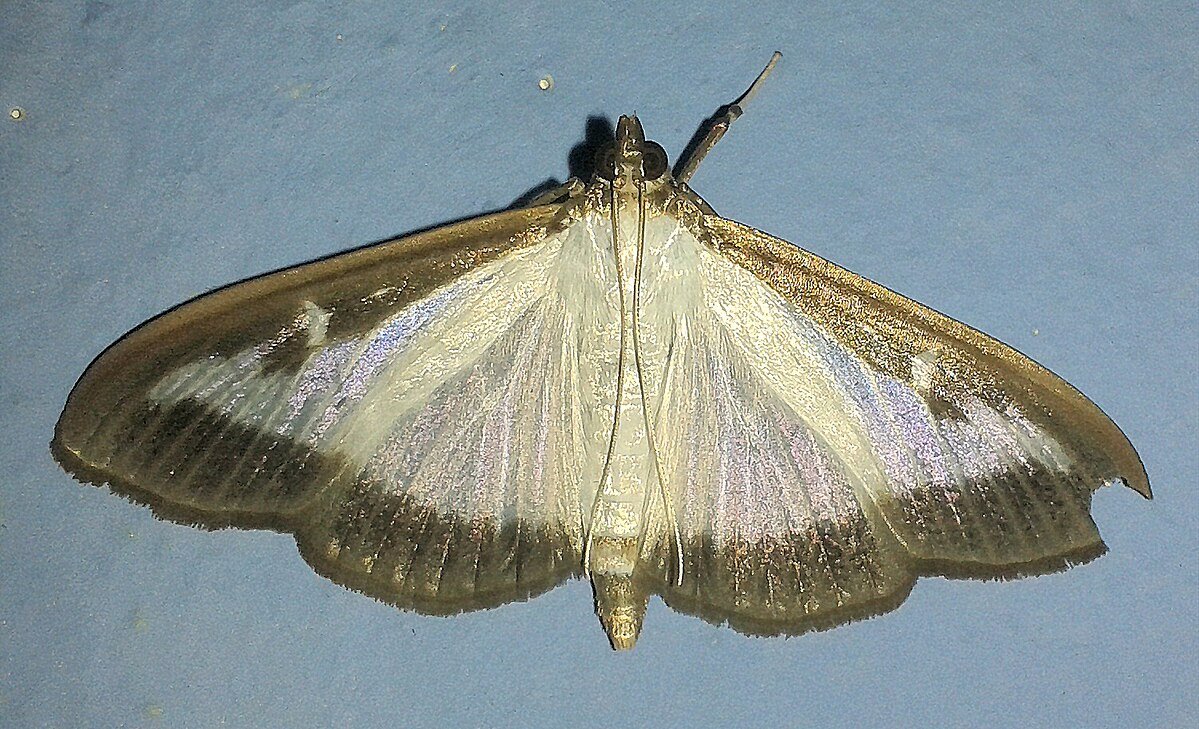
Since the eggs are laid on the undersides of leaves, they can be very challenging to see, so this stage is usually missed. The caterpillar feeding causes defoliation and stem damage, although this can be confused with boxwood blight if the larvae aren’t spotted. If you notice your boxwood foliage has damage, inspect for caterpillars and pupae webbing, which resembles spiderwebs but usually appears denser and whiter. If earlier infestation went undetected, several masses of webbing may already be present in a large portion of the shrub. The adult moth is most commonly white with brown edging, with a wingspan of about 4 cm (1.5 in). More rarely, the moth will be brown with white flecks on the wings.

Ways to manage
If the population is small enough, caterpillars can be safely hand-picked and disposed of. However, as they can be difficult to detect unless there is already noticeable damage, there may be too many for this to be worthwhile. In Canada, the biological pesticide Bacillus thuringiensis subsp. Kurstaki (Btk) has proven very effective in controlling the box tree moth. Btk has been used in the forestry and agriculture industries for decades to control moth pests, and isn’t considered harmful to humans or other species. In order to work, the spray must be used when caterpillars are actively feeding; they consume the pesticide, toxins are released in their digestive systems, and they expire within days. There could be all four life stages present in the boxwood at one time, but spraying at any other stage than active larval will have no effect.
Unfortunately, spraying with Btk will probably not be a one-time effort. Because multiple generations occur throughout the season, and eggs don’t hatch all at once, several applications will very likely be necessary. Even if you make it through one season with your boxwoods intact, there is a high chance the moths will be back the following year. Constant vigilance is required in order to keep them healthy.
The future of boxwood
Right now, the box tree moth has not been found in any province west of Ontario. If you live in any province from Manitoba west through B.C., please be on the alert and notify the Canadian Food Inspection Agency if you spot any.
The CNLA is conducting preliminary research into the possibility of breeding a box tree moth-resistant shrub, giving hope that a reliable cultivar may be available in the future. In the meantime, please keep a close eye on your boxwoods and manage box tree moth quickly, so we can keep these lovely plants healthy and thriving for future generations to enjoy.
Featured image: “Box tree moth” ( Ian Alexander, CC BY-SA 4.0)

Leave a Reply