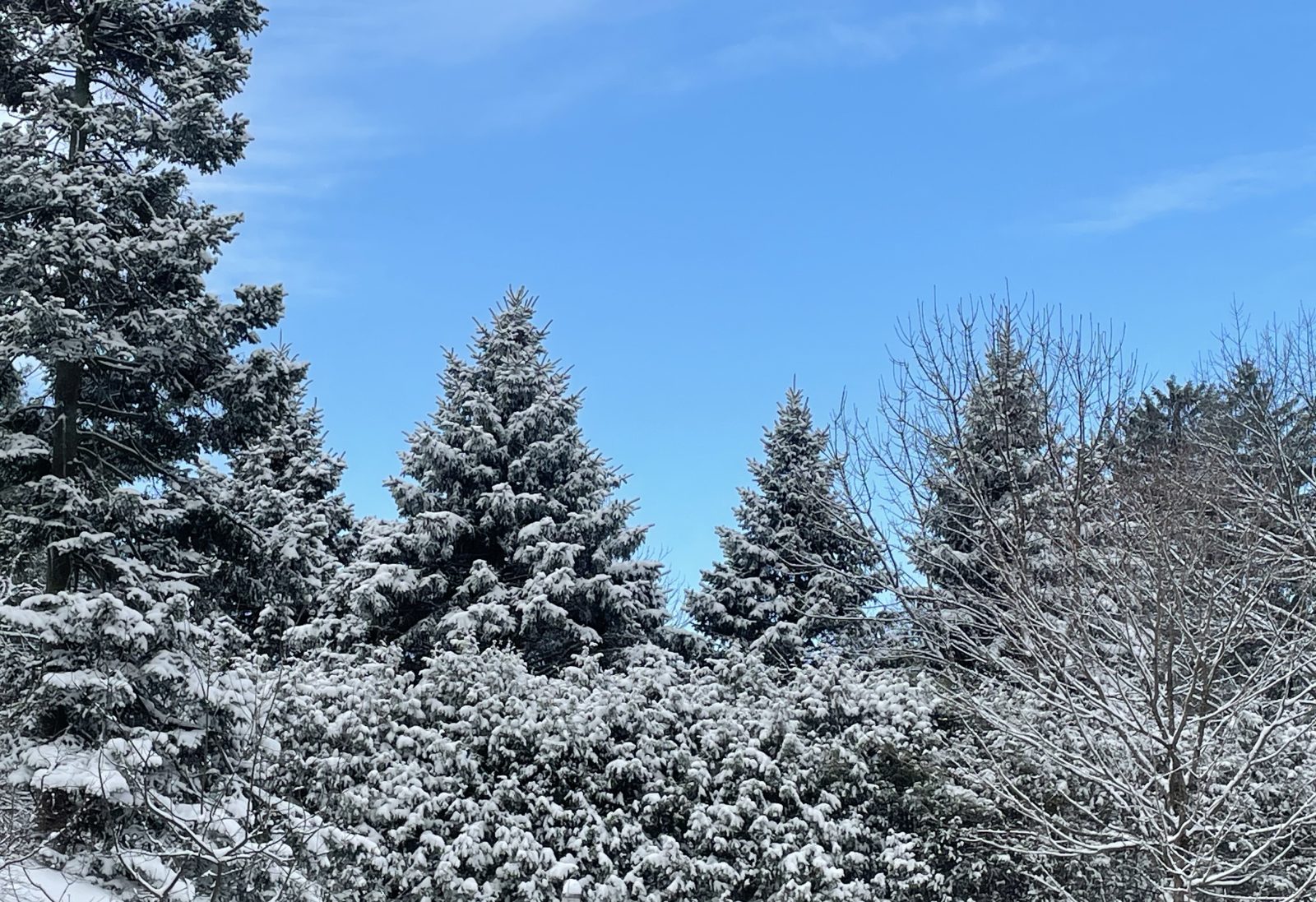
The transition from summer to winter in the garden is dramatic. Watching it go from lush plantings spilling over with colour to bare branches and frozen soil is a bit of a shock. Maybe you have to deal with snow; depending on how far north you live, you might get a light dusting, a never-ending blanket, or none. Yards can definitely look barren and boring.
But the winter garden is not quite fully asleep. It may not be filled with vibrant colours and dense greenery anymore, but with some planning, the winter landscape can still look spectacular. Create structure, form, and texture with interesting bark and branches. Sneak some colour in with stems and berries. And with a little luck, a flower or two may even show up in the dead of winter.
Here are some ideas and inspiration for planning a winter garden.
Evergreen trees and shrubs
Trees are the backbone of a garden. For a good part of the year, leafy canopies and evergreens work together to create this foundation. But once the deciduous trees have shed their leaves by the end of autumn, those evergreens are ready and waiting to pick up the slack in the winter garden.
Arborvitae (Thuja occidentalis) is a very popular hedging shrub, and provides nice thick cover for birds like cardinals and sparrows in the winter. Use them as a backdrop for other plantings, like the Fire Chief globe cedar (Thuja occidentalis ‘Fire Chief’). Its orange-red branch tips and compact rounded form make for a nice accent shrub; plant in groups for maximum impact. Hinoki false cypress (Chamaecyparis obtusa) has a unique form with gently twisting branches of fine, scale-like foliage.


Despite the name “evergreen”, you’re not limited to trees and shrubs that are green—check out some with yellow foliage. Sea of Gold juniper (Juniperus × pfitzeriana ‘Monsan’), Yellow Ribbon cedar (Thuja occidentalis ‘Yellow Ribbon’) or Glow Pop Japanese holly (Ilex crenata) will add a warm glow to the winter landscape, especially planted against a backdrop of deep green.
Or try trees and shrubs in subtle blue. Fat Albert blue spruce (Picea pungens ‘Fat Albert’) is a smaller version of the Colorado Blue, topping out at about 15 feet tall. Blue Star juniper (Juniperus squamata ‘Blue Star’) is a low-growing dwarf shrub with dense clusters of silver-tipped blue needles. For a striking specimen tree, try the Blue Cascade Atlas cedar (Cedrus atlantica ‘Blue Cascade’) with its silvery-blue needles; the branches droop to create an almost waterfall effect.


All of the above plants will hold their colour best with full sun exposure. Growing them against a backdrop of contrasting plants will help to highlight their colours.
Evergreen and semi-evergreen perennials
Some perennials are evergreen, holding onto their foliage throughout the winter. Others are semi-evergreen; in warmer zones they may keep all their leaves, while in northern zones they may lose some or all of their foliage for a short period.
Low-growing evergreen and semi-evergreen options that add winter interest include dead nettle (Lamium maculatum), coral bells (Heuchera spp.), bugleweed (Ajuga spp.), and pigsqueak (Bergenia spp.). Winter heath (Erica carnea) and lenten rose (Helleborus spp.) will also flower in late winter or early spring. To offer the most visibility, these all work best in areas without much snow cover.


As promised earlier, there are flowers that actually bloom in the middle of winter. The Ozark witch hazel (Hamamelis vernalis) is a shrub that typically begins blooming in January or February; its flowers come in a range of colours, and can bloom all the way through until April. The spidery flowers are highly fragrant and bloom on bare branches, making for a dazzling mid-winter sight.

Witch hazel flowers have a technique for surviving sub-zero temperatures. In deep cold, the petals close up tightly against the branches for protection, and when temperatures rise, they unfurl and continue blooming. The witch hazel deserves a spot where’s it’s clearly visible from inside your home, so don’t hide it in a corner of the yard—give it a spot where the sight of flowers blooming in February can be marvelled at.
Plants with berries
Give plants with berries a big role in your winter garden plan; they’ll provide the cheerful pops of colour that are sorely lacking this time of year. The fruit is also an important source of nourishment for birds and mammals in a season when food is scarce.
Plants in the holly (Ilex) family fit the bill: winterberry (Ilex verticillata) loses its leaves, but the bright red berries cling on throughout winter, while inkberry (Ilex glabra) stays evergreen and grows clusters of dark purple berries. The Blue Princess holly (Ilex x meserveae ‘Blue Princess’) is an evergreen that gives that classic Christmas holly look, with its shiny, deep green leaves and bright red berries.


Try plants with fruits in other colours: the common snowberry (Symphoricarpos albus) has creamy white berries that last throughout winter, while beautyberry (Callicarpa bodinieri) boasts clusters of incredible jewel-like purple berries. Cotoneaster (Cotoneaster spp.) has both deciduous and evergreen species; some, like ‘Emerald Beauty’, feature orange berries. All of these shrubs will look wonderful in massed plantings.
Trees and shrubs with cool stems and bark
Deciduous trees and shrubs may be bare, but that doesn’t mean they can’t make a big impact in the winter garden—they still have something to offer with interesting bark or form.

The coral bark maple (Acer palmatum ‘Sango-kaku’) has incredibly vivid red bark, making it stand out against a backdrop of evergreens or bright white snow. The paperbark maple (Acer griseum) has spectacular peeling bark in shades of cinnamon, red, and orange. And of course, there’s the tried-and-true birch (Betula nigra), with its beautiful exfoliating sheets of white bark.
Harry Lauder’s walking stick (Corylus avellana ‘Contorta’), also known as corkscrew hazel, makes a big impact with its ornately-curled branches that are even more pronounced when they’re covered in snow.

The oakleaf hydrangea (Hydrangea quercifolia) is one of those plants that looks impressive throughout every season. Its unique foliage and elegant flowers are on display throughout spring, summer, and fall. Now, winter is the time for the oakleaf to show off its distinctive bark, with the outer layers peeling away to reveal shades of copper, bronze, and mahogany.
Dogwood (Cornus spp.) has something to offer in every season, but brightly-coloured stems are its best asset in winter. A red twig dogwood like red osier (Cornus sericea) will look even more striking when paired with a yellow-stemmed species such as Cornus sericea ‘Flaviramea’.

Try a bright and cheery willow for stand-out colourful bark. The scarlet curls willow (Salix babylonica) is a lovely medium-sized specimen tree, with twisted, fiery orange-red branches. For contrast, the golden willow (Salix alba) is a similar-sized tree but boasts vibrant chartreuse branches. These willows can grow quite quickly, but you can prune the branches to the ground every year or two in order to grow them as a smaller shrub. This hard pruning also will also result in more vivid stem colours.

Japanese kerria (Kerria japonica) is a fast-growing shrub in the rose family. In spring, it’s covered in fluffy bright-yellow blooms; when winter arrives, its unusual apple green stems are on full display.
Spent flowers and seed heads
Lastly, be selective when you’re tidying the garden in fall. Leave some spent flowers, seed heads, and flower stalks standing. Taller plants like hydrangeas, coneflower, and black-eyed Susan will poke up through the snow, adding a bit of extra interest, and provide nesting materials and seeds for birds. And leaving small piles of leaves in a few places will offer crucial habitats for overwintering insects.
November 7, 2026
Leave a Reply